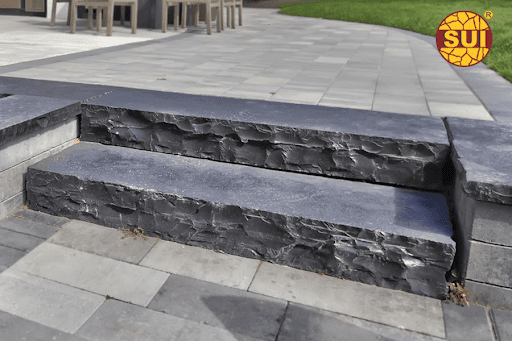
Every commercial property has areas that experience continuous and repeated use. Entrances, walkways, garden connections, and elevation changes experience daily pressure from people moving in different directions, without slowing down. These spaces must function smoothly without becoming a safety risk or a maintenance burden.
In such environments, outdoor stone steps are a preferred solution. Not because they are fashionable, but because they solve practical problems that commercial properties face year after year. Stone steps support movement, manage slopes, and maintain stability under conditions where weaker materials begin to fail.
Real Foot Traffic Is Hard on Materials
High-traffic commercial spaces are not controlled environments. People walk fast, stop suddenly, carry weight, drag luggage, and push carts. Weather adds another layer of stress, especially in outdoor settings.
Materials like wood break down under moisture and repeated impact. Concrete chips along edges, where foot traffic concentrates. Composite materials can fade, crack, or lose texture over time.
Stone behaves differently. It is dense, heavy, and naturally resistant to surface wear. Outdoor stone steps are not dependent on coatings or finishes to perform. Their strength exists throughout the material, not just on the surface. This is why stone steps retain their shape and usability long after other materials show signs of fatigue.
Structural Simplicity That Works
One of the reasons stone steps perform well is their simple construction. Steps are made from rectangular stone blocks designed for easy stacking and a neat finish. This form is not accidental.
Rectangular blocks maintain consistent riser heights and tread depths. In commercial settings, even small inconsistencies can cause discomfort or accidents. When people use steps repeatedly, they expect uniform movement. Stone blocks support this expectation.
The stacked design also improves load transfer. Weight moves vertically through the stone and into the base layer below. This reduces shifting, settling, and uneven wear, which are common issues with lighter or segmented materials.
Managing Slopes Without Overengineering
Commercial settings include slopes, level changes, and elevation transitions. Parking lots may sit below entrances. Courtyards may step down into gardens. Service paths may cross uneven ground.
Stone Steps are ideal for transitions on sloped landscapes, porches, or garden levels because they provide clear, structured movement. Instead of forcing long ramps or awkward grading, steps create direct and intuitive paths.
People instinctively understand steps. They slow slightly, adjust their stride, and move forward with confidence. This natural behavior reduces hesitation and confusion, especially in public spaces where visitors may be unfamiliar with the layout.
Predictable Safety Through Material Choice
Safety in commercial properties is not just about compliance. It is about reducing uncertainty.
Stone steps offer predictable footing. Their natural texture provides grip, even when wet. Unlike smooth concrete or metal, stone does not become dangerously slick under light moisture.
Clear step edges help users judge depth and height accurately. Consistency in shape and spacing allows people to move without constantly looking down. This matters in busy environments where attention is divided.
Stone also remains stable across temperature changes. It does not soften in heat or become brittle in cooler conditions. This stability keeps step geometry reliable throughout the year.
Maintenance That Does Not Interrupt Business
Maintenance is one of the most overlooked costs in commercial exterior design. Frequent repairs disrupt operations, create safety risks, and increase long-term expenses.
Stone steps require minimal maintenance. They do not peel, rot, rust, or delaminate. Routine cleaning is usually enough to keep them functional and presentable.
In high-traffic areas, this durability becomes a major advantage. Property managers avoid repeated patchwork repairs and emergency fixes. Over time, the reduced maintenance demand lowers ownership costs and improves site reliability.
Aging Without Losing Function
Commercial properties change. Tenants rotate. Landscapes evolve. Branding updates occur. Exterior elements must adapt without becoming visual or functional liabilities.
Stone steps age slowly and evenly. They do not fade dramatically or develop sudden defects. Minor surface changes tend to blend naturally rather than stand out as damage.
This makes stone steps a stable foundation around which other design updates can occur. Instead of forcing replacements, they continue to support evolving site needs.
Visual Order Without Distraction
Stone steps contribute to visual clarity rather than decoration. Their rectangular form creates clean lines and defined movement paths. This order is valuable in commercial settings where clarity matters more than ornamentation.
Because stone has a neutral, natural appearance, it works across architectural styles. It does not compete with signage, facades, or landscaping features. Instead, it supports them quietly.
This visual restraint is what keeps a commercial property looking professional over time.
Long-Term Practical Value
When choosing materials for high-traffic areas, long-term performance matters more than short-term savings. Replacing or repairing steps repeatedly costs far more than installing a durable solution once.
Stone steps deliver value through longevity. They withstand constant use, weather exposure, and structural load without frequent intervention. For property owners and managers, this reliability simplifies planning and budgeting.
The result is an exterior access system that performs consistently, without drawing attention to itself for the wrong reasons.
Conclusion
High-traffic commercial properties require exterior solutions that perform under pressure. Stone steps meet this requirement through strength, consistency, and long-term stability.
When steps are formed from rectangular stone blocks, they provide reliable transitions across sloped landscapes, porches, and garden levels while supporting heavy daily use. Their resistance to wear, low maintenance needs, and predictable safety make them a practical choice for demanding environments.
For commercial projects that prioritize function and durability, Stone Universe Inc. provides stone step solutions designed for real-world use. By focusing on material quality and proven formats, Stone Universe Inc. supports outdoor access systems that continue to perform long after installation is complete.